Showing posts with label Planning. Show all posts

Friday, 31 January 2014

(Pr) Filming Check List

For my second day of filming I've decided to develop a check list to remind me of what props I need to bring with me and also what shots and scenes I need to film:

Light Becky mise-en-scene
  • White baggy t-shirt
  • Denim Shorts
  • White converse
  • Floral crown
  • Pink lipstick
  • Neutral make-up
  • Blue fluffy jumper
  • Pink skirt
Dark Becky mise-en-scene
  • Red dress
  • Black boots
  • Dark, black eyes
  • Bow in hair
  • Red lipstick
  • Rings
  • Black nails
Props
  • Fairy lights
  • Candles
  • Flower petals (for bath)
  • Blanket (for picnic)
  • Chocolates
  • Bed
Scenes to shoot - Light Becky
  • Romantic bath w/ petals floating on top surrounded by candles
  • Becky baking and throwing flour at the camera
  • Laid in bed
  • Candlelit dinner
  • Picnic
  • Eating chocolates
  • Make a heart out of tea lights
Scenes to shoot - Dark Becky
  • Walking through woods - fairy lights in bush
  • Walking along road with heels in her hand
  • Walking outside a church - to show religious, deathly elements
  • Blowing a kiss / pursing her lips
  • Stood in a field with trees behind, twirling around, acting crazy

Thursday, 23 January 2014

(Pr) Artist Profile

(Click image to enlarge)

Above is a small fact file and summary on my artist.

My reason for creating this is because I need to be original with my ideas, although my new artist is still very similar to Lana Del Rey she is a completely new person.

Thursday, 16 January 2014

(R/P) Camera Shots


Establishing Shot
An establishing shot captures the location/setting and time of the narrative and thus adds depth to a frame. This shot is generally used at the start of a production to show the setting for the storyline.

Extreme Long Shot
An extreme long shot can be taken as much as a quarter of a mile away, and is usually used as a scene-setting, establishing shot. The shot normally shows an exterior (the outside of a building or a landscape) and is often used to show action scenes, e.g. in a war film. An extreme long shot tends not to have too much detail in it, it is just meant to give a general impression.

Long Shot/Wide Shot
A long shot is a shot that lets the audience see the whole of a person's body, i.e. it captures their head and body in the same frame. This shot can also show an entire object, not just a human body, e.g. a house. This shot allows the audience to see a character's costume and presentation and therefore allows the audience to make judgements. The relationship between the character and their surroundings can also be established.

Mid Shot
A mid shot shows some part of the subject in more detail than a long shot, whilst still giving an impression of the whole subject. This shot captures a character from the waist up and allows the audience to become familiar with a character because they get to see their facial expression and body language in more detail.

Close-up
A close-up generally shows the heads and shoulders of a character so that the audience can focus on the character, or an object or a detail that is significant to the narrative. This type of shot is useful to show a subject's emotions.

Extreme Close-up
An extreme close-up shows extreme detail, i.e. a subject's eye takes up the whole frame. This type of shot can be useful to show intricate detail. An extreme close-up is quite unfamiliar for an audience and therefore can heighten mood and increase tension due to the intensity of the shot.

Two Shot
A two shot does what it says in the name: features two people in a shot. It is usually framed similarly to a mid shot and shows the relationship and the situation the characters are in.

Point of View Shot
This shot shows the view from the subject's perspective and is used to engage audiences with characters and their motives.

Cut In
This shot shows another part of the subject in detail.

Cut Away
This shot cuts away from the current subject and shows something else.

Over the Shoulder
An over the shoulder shot shows the subject by looking from behind another person. This shot can be useful for putting the character's social position into context.

Weather Shot
Again, this shot does what it says in the name: the subject of this shot is the weather and can be useful for setting the scene.


Tracking Shot
This involves either a backward or forward movement with the camera. Tracking draws the audience into the action, with tracking out signifying the end of the action in that scene.

Tilt Shot
This is where the camera lens moves up or down whilst keeping its horizontal axis constant. An upward tilt usually connotes power or status, and mixed with a point of view shot it can show how a character perceives another character in terms of authority.

Zoom
Zooming involves changing the focal length of the camera lens to make the subject appear closer of further away in the frame. This camera movement should be used carefully as excessive zoom use can make a production look amateur.

Pan
Panning involves moving the camera lens to one side or another, i.e. left then right. Used with a point of view shot, it could simulate a character searching a room.

Pedestal
This involves moving the camera up or down without changing its vertical or horizontal axis. Pedestal up means to move the camera up, whereas pedestal down means to move the camera down. The lens isn't tilted, the entire camera is moved either up or down. 

_____________________________________________________________________


A lot of these different shot types and camera movements will be used in my music video. I will use lots of 'weather shots', as nature will be prominent in my video, as well as numerous long shots, for example a shot of the chapel which will help my audience establish the connection between the character and her surroundings. There will be no two shots used however, as there is only one physical character in my music video. I'm also keen to use a few point of view shots, although the point of view won't be from Becky, the physical character, the point of view will be from the 'person' who is behind the camera. 

For 'Dark Becky' mostly more static shots will be used, although I will probably include tracking and pan movements, whereas for 'Light Becky' the camera will move around a lot more, as it will be as though a loved one is filming her.

Source here

Friday, 10 January 2014

(P) Digipak Practice


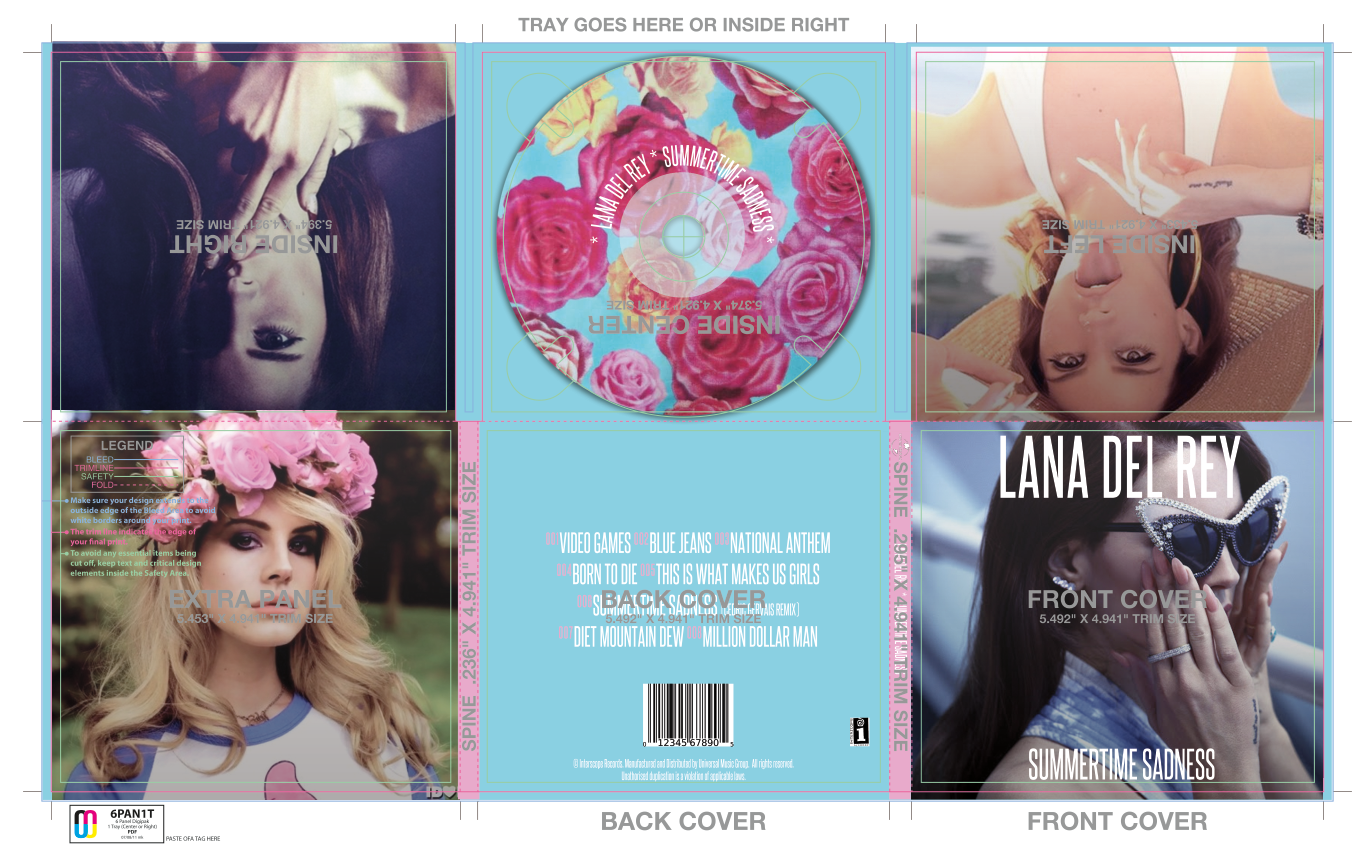
Before I made my actual digipak, I wanted to practice creating one first. Above is my first try at a digipak. The first image is the product with the guidlines still in place, the second image is what the digipak would look like printed out.

For this practice I did a Google search for Lana Del Rey digipaks and tried to conform to some of what I found, i.e.:
  • a barcode
  • a copyright infringement
  • the record label's logo
  • Lana Del Rey's signature font
  • the use of strong, determined poses
Three out of four of the photographs I used feature Lana Del Rey giving off a strong direct gaze to the camera, although the cover image I used features Del Rey looking away with sunglasses covering her eyes which is very unconventional for her. My reason for doing this is because I didn't want to conform to all the conventions, although I did still want to make it apparent that it's the same old Lana Del Rey that everybody is used to which is shown through the other four photographs. 

A barcode is essential so that the digipak can actually be purchased, as well as the record label and the distributor's logo so that people recognise who created the album. 

I used soft, pastel colours as these are the sort of colours most associated with Del Rey. I chose a floral pattern for the CD because flower crowns are another part of Del Rey's signature look, so it gives the album a more personal feeling because it seems as though it's identifying with the artist.

The layout of the track names is also quite conventional of Del Rey's CDs, but I think it works effectively so I didn't want to change this.

Wednesday, 8 January 2014

(P) Target Audience


Name: Mikaila Storey
Gender: Female
Age: 17
Hobbies: Keeping up with the latest fashion trends, surfing the internet, social networking, singing, YouTubing (i.e. uploading videos, or vlogs, to YouTube), painting
Music Taste: Indie rock, dance, house, pop
Music Consumption Habits: Watches music videos on YouTube (very much about aesthetics as well as sound), listens to music on her iPod on the go, watches music channels e.g. MTV, listens to music whilst driving (on the radio)

Above is a fact file on just one of the people who will be a part of my primary target audience. Apart from just 17-year olds who enjoy painting and pop music, my music video will be primarily targeting 16-24-year old females. These females will enjoy keeping up with current music, although they might think they're still being unique by listening to Lana Del Rey who isn't necessarily of home brand status yet. Del Rey's music is primarily about heartbreak, heartache and other issues that women are stereotypically more open about compared to their stereotypical male counterparts, although that's not to say they aren't affected by these issues as well, therefore young males would make up part of my secondary target audience.

The majority of the primary audience will probably live in the UK or USA, as, statistically, America is the world's largest music market and the UK is the third biggest music market. The second largest music market is Japan, although I don't think my primary target audience would live in Japan, as English probably wouldn't be their first language so they wouldn't get the same out the lyrics and the video as English-speaking people as they don't have the same ideals and values. Therefore, Japan, and other countries with English as their second language would make up my secondary target audience.

As touched on previously, my primary target audience would keep up with the latest, most current music (i.e. the likes of the hottest DJ of the moment, Cedric Gervais), but they'd also appreciate the uniqueness of Del Rey and the fact that she isn't world-famous - they'd take comfort in knowing that her audience is still fairly small (compared to the likes of Beyonce and Lady Gaga) as this could potentially make them feel closer to the star and although them to form a personal relationship with her (Blulmer and Katz's Uses & Gratifications theory).

The music for my primary target audience wouldn't be just about sound - it'd be about the aesthetics too. They'd appreciate the music video - not just using YouTube to listen to music in the background, but using YouTube to watch their favourite music video over and over again because of the beauty and the uniqueness of the video. The music video wouldn't be about a clear, straightforward narrative - it'd be about the pure visuals: the beauty of nature, or light tricks such as bokeh - they want to be wowed by the video. My primary target audience would therefore be people who are quite creative, who appreciate the smaller things in life, who appreciate beauty and 'pretty things', purely because they're beautiful - although this sounds quite shallow, they'd also understand or create a meaning beneath the aesthetics even if a clear meaning isn't given. They're imaginative, thoughtful people, but the dance element of the song means they'd also be quite energetic and maybe outgoing. My secondary target audience would appreciate the visuals, but would probably like the music video purely because of the music.

The perfect primary target audience would be loyal to both Cedric Gervais and Lana Del Rey and therefore would buy this song legally, i.e. downloading through iTunes or by purchasing a physical copy, so that both artists are rewarding for their hard work.


Music market stats from here

Tuesday, 7 January 2014

(R/P) Fonts


Today I have spent time looking for different fonts that I think represent Lana Del Rey's style, and now I want other people's opinions on which font they like best and which they think best represents Del Rey's style. The top font is Lana Del Rey's signature font, with the second one being a font she has used on her most recent album cover, whereas the rest are just fonts I like and think could suit my magazine advert and digipak.

I have sent the link to this post out on email to my fellow media students so that I can hear their opinion on which font they like best.

Monday, 6 January 2014

(P) Practice Filming & Editing


Earlier today I filmed various, fairly random 30 second clips and now I'm using an editing programme called VideoPad in order to create a sort-of music video. My reasoning for doing this is so that I can become more comfortable with a video camera and the editing software so that when it comes to my actual music video I will be more prepared.

(P) Location


Above are photographs that I took of Clumber Park - the location where I am going to shoot my music video. In them you can see examples of the chapel and the bridge I have talked about in previous posts, as I want to use these exact locations in my music video. The other photographs just show the nature and the setting of the park so that you can get a greater understanding of what my music video location looks like.

Wednesday, 18 December 2013

(P) Storyboarding

 
Today I started storyboarding my music video so that when it comes to shooting it I will know what I need to film and in what location. The storyboard will also make the editing process easier as well, as with this it will be easier to piece each part together in the right place.

Tuesday, 17 December 2013

(R/P) Stylistic Influences


Above is an image I created using Photoshop to showcase my stylistic influences. I found all of these images on Tumblr, and I think each one captures something that I want to include in my project, be that my music video, my magazine advert or my digipak. The majority of the images have quite a surreal vibe to them, which I want to be evident in my music video, and there is also a lost vibe present as well.

The below images are included in the above image but I thought I'd post them separately as they are GIFs and therefore couldn't be portrayed properly in the JPEG image.


I really like this image of Del Rey herself and think it could look really good in my music video during Becky's happier moments, as it gives off a childish, carefree feeling.


These images are both really similar because of the sort of 3D effect used on them. I really like how effective they look, although I'm not sure if I'd be able to actually use this in my music video.

Thursday, 12 December 2013

(P) Creating Gold Text

Below is a step-by-step tutorial on how to create Del Rey's gold text (from this image).

1) I found a gold texture on Google and opened it in Adobe Photoshop

2) I then duplicated this layer

3) Next, I created an empty layer in between these layers

4) This layer is then filled with white

5) Now I select the duplicated layer and click the 'type' tool and write 'Lana Del Rey' in her signature font and make sure the selected font colour is white

6) This text layer is then dragged below the duplicated background layer

7) Again, I select the duplicated background layer, then go to Layer > Create Clipping Mask

8) Finally, I'm going to add a drop shadow and this is my final result:

I'm planning on using this technique when creating my magazine advertisement or my digipak as I think it looks really effective and professional, and also emphasises Lana Del Rey's style.

(R/P) Non-Linear Storytelling


For my music video I will use aspects of several of these different narrative types. Firstly, I will use
aspects of 'disruptive narrative' as Becky's boyfriend will never actually appear, so it's a mystery to who this person is. Secondly, I will use aspects of 'non-sequential narrative' as the events occurring in my music video will be cutting between two different summers, thus meaning there is no plain, straightfoward narrative. Finally, I will partially use aspects of 'disjointed narrative', as parts of the narrative will be repeated.

Research from here

Wednesday, 11 December 2013

(P) Practice Magazine Advertisement


Using Adobe Photoshop, I decided to create a practice magazine advertisement, using a picture of Lana Del Rey that I found on Google. For this advertisement I partially stuck to conventions, by including a main image of Del Rey looking confident and sultry, as well as including her name in her signature font at the top of the page, bigger than the song name that is also in the same font. I slightly strayed from conventions by using a drop shadow effect on the type, which Del Rey doesn't generally use on her advertisements, although this is only a slight difference.

Tuesday, 10 December 2013

(R/P) Existing Del Rey Magazine Adverts


I have created a Prezi in order to analyse existing Lana Del Rey magazine advertisements. This will help me when it comes to creating my own magazine advertisement as it helps me understand the codes and conventions of Del Rey's products.

(R/P) Barthes Narrative Codes


In my music video, there will be a huge enigma code throughout it, but this will remain unanswered which could perhaps frustrate my audience. However, I am still going ahead with this code because I believe that it will make my audience want to know more and stay interested, and they can also make up their own mind. The unanswered enigma will be the identity of Becky's lover/friend that she is mourning for during the whole video - but is she mourning because they are actually dead, or because they have left or, or what? The possibilities are endless and I want my audience to make up their own ideal to satisfy them.

Semantic codes could also feature in my music video, for example Becky will be wearing a red dress during some parts, which could connote danger, passion or romance.

Monday, 9 December 2013

(R/P) The 'Everyman' Character

The Everyman character was created so that the audience can imagine itself in the same situation without having to possess knowledge, skills or abilities outside their everyday experience. These characters act realistically in situations that are often taken for granted with traditional heroes; an Everyman character who gets into a fight would end up getting hurt, whereas an unrealistic hero would come out unscathed.

The name comes from the 15th century English morality play called Everyman.

This term will be relevant within my work, as Becky, the main character, will be illustrating feelings that the majority of my audience should be able to identify with, i.e. she will be happy and in love but also sad and heartbroken.

Friday, 6 December 2013

(R/P) Negotiated Meanings

Barthes deduced that audiences make new meanings when reading a text based on their previous experiences, as well as the text itself. For example, if there was a programme on lower class teenagers it will be perceived differently depending on the viewer; somebody in the same situation may feel differently than somebody of a higher class.

This theory could be applied to my work, because my audience may have to have experienced heartbreak or the death of somebody close to them in order to fully understand the narrative of my music video, as the main character in my video will be suffering from heartbreak after her loved one has died.

Thursday, 5 December 2013

(P) Treatment Script


To make my 'final idea' video easier to understand I have decided to write up a script for it using Scribd.

(R/P) Encoding and Decoding

In the 1980s, Stuart Hall, a British sociologist, developed a theory which highlights the importance of active interpretation when it comes to the creation of meaning. This theory is called 'Encoding and Decoding' and it focuses on how meaning is created and then understood by the audience.

Encoding
The director/creator's intended meaning is encoded based on their ideologies, aims and intentions and the technology available to them.

Decoding
The audience decodes the meaning based on their ideologies, aims and intentions and the technology available to them.

How can this be applied to my music video?
This theory can be applied to my work because I will be encoding the video with my own ideologies and intentions. In the video, my intent will be that Becky is mourning over the death of her boyfriend after he died tragically and young, although it won't be clear in the video why she is actually sad, but there will be enigma codes, i.e. her giggling and smiling at the person behind the camera, which gives the audience the impression that this person is no longer around when she is appearing sad and mournful. This 'person behind the camera' can be anyone the audience wants them to be: a lover, a friend, a family member; male or female - whoever they want. The reason for this person not being around anymore is also a mystery, so the audience are left to decode that how they want to as well in order to create their own ideal.

Wednesday, 4 December 2013

(P) Final Idea / Treatment


Above is a video of me explaining my final idea for my music video. Several things I've realised I've missed out however include:
  1. The time of day that I will be shooting my video - I've researched when the best light appears, and dawn seems like a very effective time of day to shoot 'dark Becky', as this is when there's a very blueish, cold light which could give off a very effective, 'sad' feel. Furthermore, for shooting scenes of 'light Becky' I could use sunrise, as the colours are generally very warm, as well as dusk when the camera shoots colours richer than what the eye can see.
  2. The overall narrative of my music video will be quite simple - dark Becky will be illustrating her pain from losing her loved one, whereas light Becky will be illustrating her happiness from being with her loved one. It will be a very simple tale of romance and tragedy, which although cliché, can be very effective and appealing to audiences.
  3. Dark Becky and light Becky are binary opposites, so in order for my audience to understand one, they have to understand the other.
  4. When editing my video I want to try a layering effect with shots, so that one shot is a couple of seconds faster than the same shot. This effect gives a very surreal, disorienting effect which I believe would look very effective in my video.
  5. In the video I said that I wanted to create a time lapse of 'traffic lights'. By this, I meant a time lapse of cars moving with their lights on. Although I also wanted to create a time lapse of the sunset or sunrise as this would look very peaceful in my video.
  6. The fast, dance parts of the music will illustrate Becky's happiness, whereas the slower bits will illustrate her pain.